Italian stone exports: value up, volumes down
FRIDAY, 18 SEPTEMBER 2026
Average price at 1,234.6 dollars per tonne, an all-time high. China buys over half the raw blocks, the United States leads on processed goods.
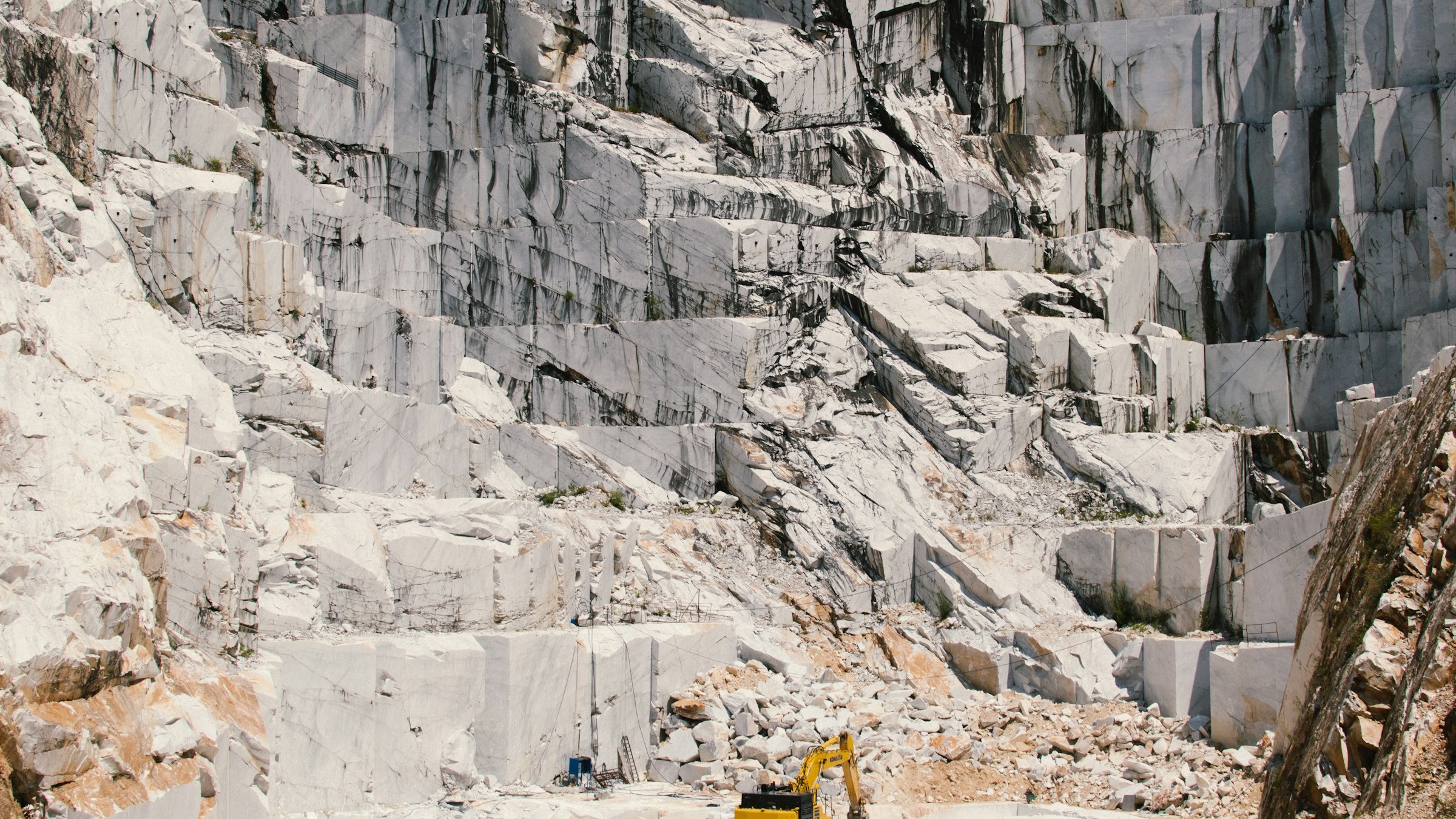
Italian stone exports grew 5.5% in the first half of the year, but the tonnes shipped fell. It is a textbook case in how to read an export figure, and it applies to any sector, not only to marble.
Italian stone exports: the first-half figures
The data come from the research centre of Confindustria Marmomacchine, released ahead of Marmomac, scheduled in Verona from 22 to 25 September.
- Stone sector exports in the first half of 2026: 1,690 million dollars, up 5.5%
- Natural stone: 1,231 million dollars, up 8.2%
- Extraction and processing technologies: 459.2 million dollars, down 0.9%
- Volumes of stone exported: down 3.3%, around 997 thousand tonnes
- Average export price: 1,234.6 dollars per tonne, an all-time high
On the other side imports fell 5.1%, to 245 million dollars, and the sector's trade surplus rose 7.6%, to 1,445 million.
Value rises, tonnes fall
Here is the reading that matters. Sales of natural stone grow 8.2% in value while volumes fall 3.3%: the growth does not come from more goods sold, it comes from a higher average price and a mix shifted towards products worth more.
The figure that confirms it is the average price, which reached 1,234.6 dollars per tonne, with processed products above 2,000 dollars per tonne for the first time. Within the aggregate, processed and semi-processed goods grow 7.5% and raw blocks 10.6%.
It is worth saying why the distinction is not academic. Growth driven by volumes signals rising demand and, sooner or later, pressure on production capacity. Growth driven by price signals better positioning, or simply costs passed downstream, and says nothing about how full the plants are. These are two situations calling for different decisions on stock, investment and negotiation.
A note on the volume figure: the correct number is in the hundreds of thousands of tonnes, not millions. It follows from dividing the exported value by the stated average price, and it is a check worth making whenever a release reports value, volume and unit price together.
Who buys what
The breakdown by market describes two very different flows, and is more instructive than the headline figure.
On raw blocks the leading buyer is China, with 144.6 million dollars and a share above half the total, up 19.5%; India follows with 30.1 million, up 17%. On processed products the ranking changes completely: the United States first with 323.5 million, up 7.5%, then Germany at 66.3 million, Switzerland at 62.4 with a 27.7% rise, France at 58.1 down 1.7% and the United Arab Emirates at 41.2 million, up 24.9%.
In short, Italy sells the raw material mainly in Asia and the finished product mainly in North America and Europe. It is a snapshot, not a judgement: it describes where the processing sits, not whether it is best placed there.
Machinery moves the other way
Extraction and processing technologies are the only segment falling, by 0.9%. According to the association this reflects the stagnation of world stone trade, lower appetite for investment in markets such as North America and the Middle East, and international competition, Chinese in particular.
On that last point it is worth being precise: Italy and China each hold a share close to 30% of the world market for these machines. That Chinese competition weighs is the association's explanation, not an isolated measurement; the figures say Italian machinery exports are flat, not how much of that flatness is due to whom.
What to take away, even if you do not trade marble
The first point is checking the sign. When you receive an export figure showing growth, ask for or look up the corresponding volume: if it is not growing, you are looking at a price effect, and the operational consequences differ from those of rising demand.
The second is the internal consistency of press releases. Value, volume and average price must add up: when they do not, one of the three is wrong, and working out which takes thirty seconds of arithmetic.
The third concerns your own markets. If you sell or buy abroad, this sector's split between raw and processed shows how differently two markets for the same product can behave: the aggregate average hides both.
With La Merce, reading Italian stone exports means always putting volume next to value before drawing conclusions, because in the first half of 2026 those two numbers moved in opposite directions.
Sources
Independent checks on the figures cited, verified in-house.
Read related articles
Italian exports in the second quarter of 2026: what the +7.9% really says

China producer prices are rising: what changes for buyers

WTO barometer: world trade is growing, but containers fall below trend
Fashion imports from China down 8.1%: what the figure says about suppliers

Chinese exports to Europe: just +6.6% while the rest of the world races ahead
Beyond the electric car: China's new export wave of robots, AI and medicines

How much does China really export? Figures and opportunities of the trade giant

The 5 questions we always ask our suppliers
Diesel price at 2026 highs: what reaches your deliveries
Suez transits: the return is mostly on voyages back to Asia
European steel protection and the bill for those who transform it
The Italian small parcels tax is postponed to 30 November

China's electronics five-year plan: 30 trillion yuan by 2030
German import VAT reform: less cash tied up at the port
Four Gemini services return to the Suez Canal: what changes for Ligurian ports
Container inspections: deficiencies in more than one unit in ten

Digital customs in Norway: with Digitoll, who reports what changes
Italian hyper-depreciation: confirmation due 60 days after approval

European preference in public procurement: bids below 50% can be rejected

Lithium batteries in containers: thousands travel undeclared
Congestion at Chinese ports: ten-day waits before Golden Week

SVHC substances and importer obligations: the list rises to 253 entries
Hyper-amortisation and foreign machinery: the Made in EU rule is dropped

Ten-T corridor delays Italy: Confetra's warning on Brenner and Terzo Valico

Panama Canal draft restrictions: Neopanamax cut postponed

Shanghai-Genoa container rates down 10%: what changes for those importing from China

Demurrage and detention charges disputed: Samsung seeks $186 million from CMA CGM at the FMC

Back to Suez: transits up 36% in August, but the route is only halfway there
Steel imports: "melt and pour" traceability starts on 1 October
China-Europe air cargo: the decline stops, what changes for importers

Goodbye to the €150 exemption: the EU parcel duty rewrites the rules of e-commerce imports
Steel: EU 50% tariff and new origin rules — what changes for importers

Air freight: when cargo takes flight, every detail counts

Customs checks on electronics imports: how to avoid penalties and optimise compliance
The Bialetti Moka changes hands: one of Italy's most iconic objects becomes Chinese

MSC is about to buy up ports around the world for 23 billion dollars

Import-export of jewellery and precious metals: what Italian law really says
OEM vs ODM: two key acronyms for creating a product under your own brand

Incoterms: the basics of international trade